


Semiconductor Facility Measurement Solutions: From Cleanroom Environments to CDA and Cooling Water System Applications

Semiconductor Facility Measurement Solutions: From Cleanroom Environments to CDA and Cooling Water System Applications
Semiconductor manufacturing facilities rely on the integrated operation of utility systems such as cleanrooms, HVAC and airflow systems, Compressed Dry Air (CDA), cooling water, and process auxiliary piping. Although these infrastructures are not directly involved in wafer processing, they play a critical role in equipment operation, environmental stability, and overall facility management efficiency.
Without real-time and continuous measurement data, issues such as temperature and humidity deviations, abnormal cleanroom differential pressure, uneven airflow distribution, pipeline pressure fluctuations, insufficient cooling water supply, or increased moisture content in the CDA system can be difficult to detect at an early stage. Through multi-parameter measurement—including temperature, humidity, dew point, air velocity, differential pressure, pressure, flow, level, and air quality—facility managers can establish a more comprehensive measurement foundation for anomaly detection, maintenance scheduling, and system optimization.
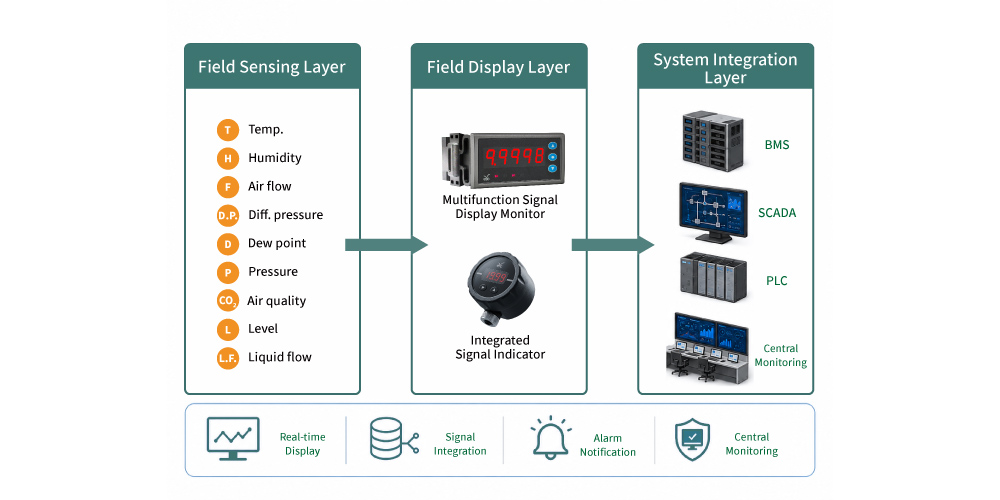
eyc-tech offers a comprehensive range of transmitters covering environmental conditions, airflow, dew point, pressure, flow, level, and air quality measurement. These products support standard industrial output signals, allowing seamless integration with existing BMS, SCADA, PLC, local display instruments, and data acquisition systems. By implementing multi-point measurements from environmental monitoring to process pipelines, semiconductor facility managers can gain real-time visibility into system conditions, reduce troubleshooting time, and improve the management efficiency of utility systems.
Cleanroom and Equipment Surrounding Environment Measurement
Semiconductor cleanrooms and the surrounding environments of process equipment require stable temperature, humidity, and differential pressure to be maintained over extended periods. In addition to the overall environmental conditions within the manufacturing area, microenvironmental changes may also occur inside equipment, around machinery, or within localized areas due to heat generation, cooling processes, exhaust airflow, or uneven air distribution.
The THS17-MD Temperature and Humidity Transmitter features a compact short-probe design, making it suitable for installation inside space-constrained equipment, around machinery, or at localized environmental measurement points. It is designed to monitor temperature and humidity variations within small areas. When localized temperature increases, humidity deviations, or airflow adjustment requirements occur around equipment, the measurement data can provide valuable references for facility managers and maintenance personnel.
The THS30X Series Multifunction Temperature and Humidity Transmitter are designed for larger manufacturing areas and cleanroom environments, providing long-term environmental measurement data. Through multi-point deployment, facility managers can monitor the temperature and humidity distribution across different areas, providing a reliable basis for HVAC adjustment, environmental stability assessment, and routine facility inspections.

FFU, MAU, AHU, and Duct Airflow Measurement
FFUs (Fan Filter Units), MAUs (Make-up Air Units), AHUs (Air Handling Units), and various duct systems play a vital role in cleanroom air exchange, differential pressure control, airflow distribution, and energy consumption. When air velocity is insufficient, airflow volume decreases, or filter pressure loss increases, uneven airflow distribution may occur, resulting in higher fan loads and increased maintenance costs.
The FTS140 and FTS34/35 Air Velocity Transmitter can be installed in air ducts or equipment air passages to measure supply, return, and exhaust airflow conditions. With real-time air velocity data, facility managers can monitor airflow variations across different areas and use the information as a reference for airflow adjustment and equipment performance evaluation.
The AFMC and AFMP Average Flow Measuring Tubes (Pitot Tube) are suitable for both large- and small-diameter duct systems. By utilizing multi-point averaging measurement, they provide representative air velocity data across the duct cross-section. Compared with single-point measurement, average flow measuring tubes are better suited for large ducts or applications where airflow distribution is less uniform.
The PMD330 and PMM330 Differential Pressure Transmitter can be installed across filters, fans, or large air handling units to evaluate filter pressure loss, blockage conditions, and equipment loading through differential pressure measurement. As differential pressure gradually increases, facility managers can use the measurement data to schedule filter replacement or equipment inspection, reducing the uncertainty associated with maintenance based solely on fixed service intervals.

CDA (Compressed Dry Air) Dew Point Management
Compressed Dry Air (CDA) is widely used as a gas supply for equipment, pneumatic actuator operation, and process purging. If the moisture content in the compressed air is too high, it may lead to water accumulation in pipelines, unstable operation of pneumatic components, equipment corrosion, or malfunctions in process support systems. Therefore, dew point measurement is a critical indicator for managing the quality of CDA supply.
The THS88ECO and THS88MAX Industrial Dew Point Transmitter continuously monitor the dew point of the compressed air supply, helping facility managers evaluate the operating condition of air dryers and filtration systems. Compared with periodic manual inspections, continuous dew point data provides a more reliable basis for identifying CDA quality abnormalities and planning maintenance activities.
When an upward trend in dew point is detected, facility managers can further inspect the operating load of the air dryer, the condition of the filtration system, pipeline leakage, or changes in compressed air supply conditions. By utilizing real-time dew point data, CDA management can gradually transition from routine scheduled inspections to a data-driven management approach based on continuous monitoring and trend analysis.

Cooling Water and Process Piping System Measurement
Cooling water and processing auxiliary piping systems are responsible for supporting equipment cooling, fluid supply, and system circulation. Abnormal supply and return water temperature differences, insufficient flow, changes in pump differential pressure, or liquid levels outside the specified range may affect cooling efficiency and overall system operating safety.
The TP05 Temperature Transmitter is designed for temperature measurement in both liquids and air. It is suitable for installation at temperature measurement points in cooling water systems, compressed air systems, exhaust systems, and around equipment. When system temperatures deviate from normal operating conditions, the measurement data can be used to evaluate heat exchange performance, compressed air supply conditions, or changes in the equipment operating environment.
The FTC06 Temperature and Flow Transmitter can be installed in liquid pipelines to simultaneously measure water flow and temperature. It is suitable for cooling water branch lines, equipment water supply pipelines, and small circulation loops. When insufficient flow or abnormal temperatures are detected, it helps facility managers evaluate water supply conditions, cooling performance, and the operating status of the circulation system.
The FUM06 and FUM03 Ultrasonic Flow Meter utilize a clamp-on, non-intrusive measurement method, making them ideal for upgrading existing pipelines or applications were shutting down the system for pipe cutting is impractical. With clamp-on installation, facility managers can reduce installation risks while quickly establishing flow measurement points for cooling water or process piping systems.
The P048 Universal Pressure Transmitter and P063 Differential Pressure Transmitter are used for pipeline pressure and pump differential pressure measurement, helping evaluate pipeline resistance, pump operating conditions, and filter blockage. When abnormal pressure variations are detected, the measurement data can serve as a reference for inspecting pipelines, valves, pumps, or filtration equipment.
The L051 Submersible Pressure Transmitter is suitable for tanks, storage reservoirs, and water supply and drainage systems, providing continuous liquid level measurement and abnormal level alarm indication. By utilizing liquid level data, facility managers can monitor water replenishment, drainage, and storage conditions, minimizing the impact of abnormal liquid levels on system operation.

Indoor Air Quality and Equipment Area Environment Measurement
In addition to the primary cleanroom areas, independent equipment rooms, gas cylinder rooms, underground ventilation areas, workspaces, and peripheral equipment areas also require continuous monitoring of air quality and environmental conditions. These areas are closely related to personnel inspections, ventilation efficiency, and equipment maintenance. Insufficient ventilation, elevated carbon dioxide (CO₂) concentrations, or the accumulation of airborne particulate matter may affect operational safety and reduce the efficiency of environmental management.
To meet the requirements of different indoor and equipment environments, eyc-tech offers a variety of wall-mounted environmental transmitters that can be selected according to the required measurement parameters. The THG03 CO₂ Temperature & Humidity Transmitter simultaneously measures CO₂ concentration, temperature, and humidity, making it suitable for workspaces, equipment rooms, and general indoor environments. It provides essential data for evaluating ventilation conditions and indoor environmental comfort.
The GS23 CO₂ Transmitter is specifically designed for carbon dioxide concentration measurement and is suitable for workplaces, ventilation areas, or spaces with high occupant density. When CO₂ concentrations increase, the measurement data can serve as a reference for ventilation adjustment, HVAC operation, or space utilization assessment.
For applications requiring simultaneous measurement of temperature, humidity, CO₂, and PM2.5, the TGP03 Multifunction CO₂/PM2.5 Indoor Air Quality Monitor provides comprehensive multi-parameter environmental data. It is well suited for peripheral equipment areas, underground ventilation zones, or indoor environments where air quality fluctuations require close attention. With these measurement data, facility managers can incorporate indoor air quality into routine inspections and abnormal condition management.

Local Display and Signal Integration
In semiconductor facility management, measurement data must not only be transmitted to the central monitoring system but also be readily accessible at the field level. When maintenance personnel need to quickly verify equipment status, identify abnormal conditions, or perform maintenance tasks, local display instruments can significantly improve operational efficiency.
The SD05 Integrated Signal Indicator and DPM02 Multifunction Signal Display Monitor can be paired with a wide range of transmitters to provide real-time data display and local alarm outputs. Maintenance personnel can directly read measurement values at equipment locations, alongside pipelines, or inside equipment rooms, reducing the time required to retrieve information from the central monitoring system.
The DPT02 Signal Converter functions as a field signal instrument, providing current or voltage signal display, conversion, and retransmission. When multiple measurement signals need to be integrated into an existing control system, it facilitates signal conversion and data integration, ensuring more consistent data communication between field devices and the central monitoring system.
Building a Continuous Measurement Foundation for Semiconductor Facilities
The stable operation of semiconductor manufacturing facilities depends on the coordinated performance of environmental conditions, airflow systems, CDA supply, cooling water, and process auxiliary piping. When deviations occur in temperature, humidity, dew point, differential pressure, flow, pressure, or liquid level, a single measurement point is often insufficient to identify the root cause. Through integrated multi-point measurement, facility managers can compare data across different systems to determine whether abnormalities are caused by changes in environmental conditions, increased filter pressure loss, higher pipeline resistance, insufficient water supply, or reduced CDA drying performance.
eyc-tech transmitters support standardized output signals and can be seamlessly integrated with existing BMS, SCADA, PLC, data acquisition systems, or local display devices. By implementing continuous measurements from cleanroom environments and HVAC airflow systems to CDA dew point, cooling water pipelines, and indoor air quality, semiconductor facility management can gradually transition from routine scheduled inspections to a data-driven management approach based on trend analysis, anomaly comparison, and predictive maintenance planning.
In semiconductor facilities where installation costs, construction risks, and system integration requirements must all be carefully considered, transmitter-based measurement serves not only as a point-monitoring solution but also as the fundamental data infrastructure supporting facility assessment, equipment maintenance, and long-term stable operation.